







Giant Hogweed
Information Courtesy of New York Invasive Species Information (www.nyis.info)
One of New York’s most striking and dangerous invasive plants, the giant hogweed (Heracleum mantegazzianum), can make a case of poison ivy seem like a mild rash.
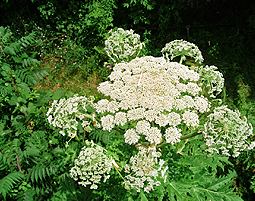 A member of the carrot and parsley family of plants (Apiaceae), giant hogweed is native to the Caucasus region of Eurasia. Because of its unique size and impressive flower head, the plant was originally introduced to Great Britain as an ornamental curiosity in the 19th century. The plant is named after the mythological god, Hercules (he of robust size and strength). It was later transported to the United States and Canada as a showpiece in arboreta and Victorian gardens (one of the plant’s first North American plantings of giant hogweed was in gardens near Highland Park in the City of Rochester, New York).
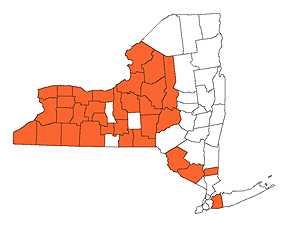 Unfortunately, as with so many invasive plants, giant hogweed escaped cultivation and has now become established in a number of areas, including: Broome, Cattaraugus, Cayuga, Chautauqua, Erie, Genesee, Herkimer, Jefferson, Lewis, Livingston, Madison, Monroe, Nassau, Niagara, Oneida, Onondaga, Ontario, Orleans, Oswego, Putnam, Schuyler, Steuben, Tompkins, Wayne, Wyoming, and Yates Counties in New York; Connecticut; the District of Columbia; Illinois; Maine; Maryland; Massachusetts; Michigan; Ohio; Oregon; Pennsylvania; Washington; Wisconsin; and Ontario and Vancouver Island in Canada.
Because of its public health hazard potential and, to a lesser extent, to its potential ecological impacts, giant hogweed is on the federal noxious weed list and several state lists of prohibited plant species.
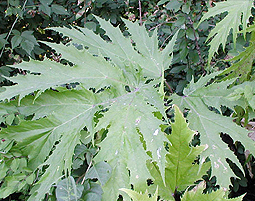 Giant hogweed can be mistaken for a number of native, noninvasive plants. The plant is a perennial herb with tuberous root stalks. It survives from one growing season to another by forming perennating buds (surviving from season to season) and enduring a period of dormancy during the winter. The plant develops numerous white flowers that form a flat-topped, umbrella-shaped head up to two and a half feet across, resembling “Queen Anne’s Lace on steroids.” Flowers form from late-spring through mid-summer. Numerous (up to 100,000), half inch long, winged, flattened oval seeds form in late-summer. Seeds can remain viable in the soil for up to 10 years. The plant’s stems die in the fall and remain standing through the winter, topped with the huge, brown dead flower heads.
Identification:
Giant hogweed may grow to 15 to 20 feet in height. Stems are 1 to 3 inches in diameter, but may reach 4 inches. Stems are marked with dark purplish blotches and raised nodules. Leaf stalks are spotted, hollow, and covered with sturdy bristles (most prominent at the base of the stalk). Stems are also covered with hairs but not as prominently as the leaf stalks. Leaves are compound, lobed, and deeply incised; can reach up to 5 feet in width. Numerous white flowers form a flat-topped, umbrella-shaped head up to two and a half feet across.
We can spray for the Giant Hogweed
Grass Genie is a licensed pesticide provider and with routine applications. It may be possible for hogweed seeds to remain viable in the soil for 10 years. For this reason, long-term monitoring is very important. Contact Grass Genie today to schedule your application - 845-225-0945.
Giant Hogweed Facts & Information:
-
Contact with its sap and then exposure to sunlight can result in burn-like lesions, massive blisters and skin discoloration. Very sensitive people can require hospitalization, and the effects can recur. And even tiny amounts of sap in the eyes can result in temporary or permanent blindness, according to state and federal advisories.

-
The only known antidote to contact with the sap is to immediately wash skin thoroughly with soap and water, removing the sap and hopefully preventing any reaction with subsequent exposure to sunlight. Once the irritation begins, medical advice should be sought.
-
Giant hogweed has the potential to spread readily and grows along roadsides, ditches and streams, invading old fields and even native habitats such as open woodlands.
-
Native to the Caucasus Mountain region between the Black and Caspian seas, the plant is identifiable by giant leaves that produce white flowers that are in bloom at this time -- from late June to mid-July.
-
Read Green Monster: New York Post
By Kate Sheehy 7/6/11 -
Read Huffinton Post: Giant Hogweed Spreading Across New York State, DEC Warns Of Burns and Blindness
-
Read LoHud: Giant Hogweed